
 ES
ES  RU
RU  TR
TR  FA
FA  AR
AR  ZH
ZH Blog
Blog description

OFAC General vs. Specific Licenses Explained: U.S. Sanctions Authorization, Compliance Risks, and Enforcement Protection
Economic sanctions compliance in the United States runs on a strict-liability standard. In plain terms: you don’t have to mean to violate sanctions to be in violation. For businesses, banks, investment funds, law firms, and multinational executives, the difference between an OFAC General License (GL) and a Specific License (SL) isn’t a technical footnote, it can determine whether a transaction moves forward smoothly or turns into a costly enforcement problem.
It’s directly tied to civil penalty risk, reputational exposure, and overall enterprise risk management.
This guide breaks down how licensing works under the U.S. sanctions system administered by the Office of Foreign Assets Control (OFAC) — and why getting the licensing analysis right, from the start, matters more than most companies realize.
Statutory Foundation of OFAC Licensing Authority
OFAC’s licensing power derives primarily from two statutes:
- International Emergency Economic Powers Act (IEEPA)
- Trading with the Enemy Act (TWEA)
Under these authorities, OFAC may:
- Block property and interests in property
- Prohibit transactions involving designated persons
- Impose sectoral or comprehensive embargoes
- Designate individuals and entities as Specially Designated Nationals (SDNs)
However, OFAC may also authorize certain otherwise prohibited activity through two licensing mechanisms:
- General Licenses (GLs)
- Specific Licenses (SLs)
Understanding the functional and legal differences between these two categories is essential to a sanctions compliance strategy.
What Is an OFAC License?
An OFAC license is an official authorization permitting conduct that would otherwise violate U.S. sanctions regulations codified in Title 31 of the Code of Federal Regulations (31 C.F.R.).
Licenses fall into two structurally distinct categories:
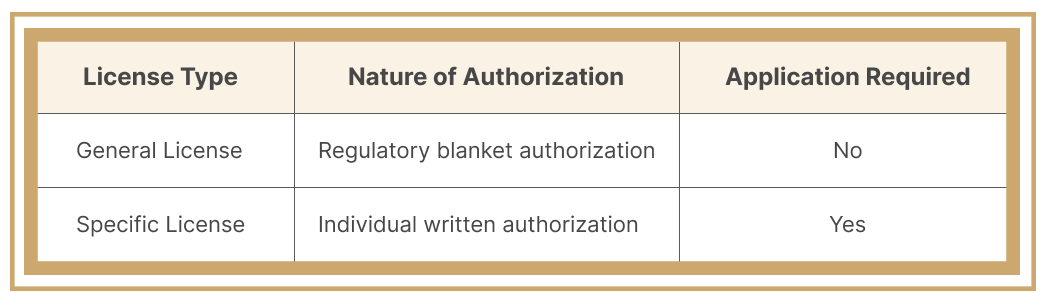
Each carries different legal risks, evidentiary implications, and compliance obligations.
OFAC General Licenses (GLs)
Definition
A General License allows a clearly defined category of transactions to move forward without filing an application with OFAC. If your transaction fits squarely within the wording of the General License, and you meet every condition, reporting requirement, and limitation: then it is authorized.
The key word is “squarely.” Close enough is not enough. The transaction has to align precisely with the license language and its conditions.
General Licenses are:
- Published in OFAC program regulations (31 C.F.R.)
- Issued as numbered standalone GLs (e.g., Russia GL 13E, Iran GL D-2, etc.)
- Publicly available
- Subject to amendment, expiration, or revocation
Common Categories Authorized by General Licenses
Depending on the sanctions program (e.g., Russia-related, Iran, Cuba, Syria, Venezuela, Global Magnitsky), General Licenses frequently cover:
- Provision of certain legal services
- Wind-down transactions following new designations
- Humanitarian exports (food, medicine, medical devices)
- Agricultural commodities
- NGO and civil society activities
- Telecommunications and internet communications services
- Remittances under specified thresholds
Important: Authorization under one sanctions program does not automatically extend to another.
Compliance Risks of Relying on a General License
Many OFAC enforcement actions stem from misinterpretation of GL scope.
Common compliance failures include:
- Overbroad reading of permissive language
- Failure to comply with reporting requirements
- Ignoring expiration dates or amendments
- Misapplication across sanctions programs
- Failure to account for the OFAC 50 Percent Rule (blocked status extends to entities owned ≥50% in aggregate by SDNs)
- Not analyzing indirect facilitation risk
Because OFAC operates under strict liability, even technical deviations may trigger civil penalties.
When Reliance on a General License Is Defensible
Reliance on a GL may be appropriate where:
- The transaction clearly falls within regulatory text
- All parties are screened
- Ownership analysis confirms no blocked entities
- Recordkeeping is thorough
- Reporting is timely and complete
- Counsel has documented interpretive analysis
In high-risk or politically sensitive matters, reliance on a GL without deeper analysis can materially increase enforcement exposure.
OFAC Specific Licenses (SLs)
Definition
A Specific License is a written authorization issued directly by OFAC in response to a formal license application submitted through the OFAC licensing portal.
Specific Licenses are:
- Fact-specific
- Transaction-specific
- Time-limited or condition-based
- Discretionary
- Subject to interagency review
When Is a Specific License Required?
A Specific License is typically required when:
- Releasing blocked funds
- Settling litigation involving SDNs
- Paying extraordinary legal fees
- Executing divestitures involving sanctioned persons
- Conducting complex cross-border restructurings
- Transactions exceed GL monetary caps
- No applicable General License exists
- Regulatory interpretation is ambiguous
In borderline cases, applying for a specific license may significantly mitigate enforcement risk.
OFAC Specific License Application Process
Applications must be submitted electronically and generally include:
- Full identification of all parties (including ultimate beneficial owners)
- Detailed transactional narrative
- Copies of contracts and agreements
- Financial flow diagram
- Jurisdictional nexus analysis (U.S. persons, U.S. currency clearing, U.S. goods, etc.)
- Legal justification under relevant sanctions program
- Explanation of policy considerations
Processing Time
License review timelines vary significantly:
- Straightforward humanitarian requests: weeks to months
- Politically sensitive matters: several months or longer
- High-value or litigation-related matters: extended review possible
Incomplete submissions materially delay processing.
General vs. Specific License: Detailed Comparison
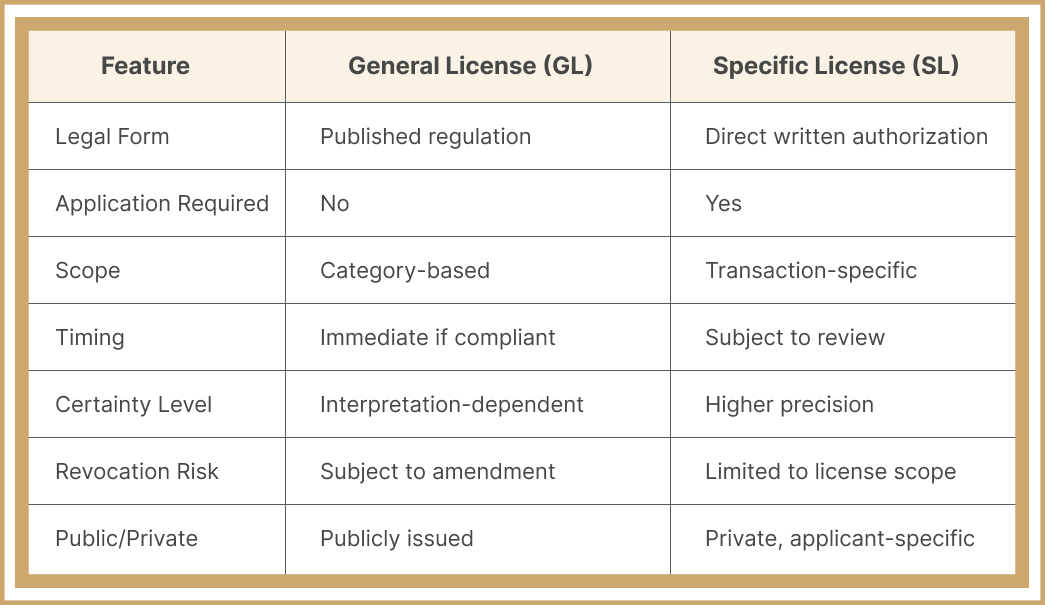
In enforcement defense, documented reliance on a specific license often provides stronger mitigation arguments than informal reliance on GL interpretation.
Enforcement Risk Under IEEPA
Under the International Emergency Economic Powers Act (IEEPA), civil penalties can be severe. In many cases, they reach the greater of:
- The statutory maximum per violation (adjusted annually for inflation), or
- Twice the value of the underlying transaction
In other words, the exposure is calculated to hurt—either by a fixed ceiling that rises each year, or by tying the penalty directly to the size of the deal.
OFAC applies its Enforcement Guidelines considering:
- Willfulness or recklessness
- Sanctions-risk knowledge
- Compliance program adequacy
- Repeated violations
- Harm to program objectives
- Voluntary self-disclosure
A well-structured licensing analysis—whether GL reliance or SL application—can be dispositive in enforcement mitigation.
Strategic Sanctions Compliance Framework for Businesses
Organizations operating in high-risk jurisdictions (e.g., Russia, CIS markets, Middle East, sanctioned sectors) should implement:
1. Licensing Review Protocols
Mandatory internal review before engaging in high-risk transactions.
2. Transaction Mapping
Detailed financial and operational flowcharts to identify sanctions nexus.
3. Beneficial Ownership Analysis
Explicit screening under the OFAC 50 Percent Rule.
4. Escalation Procedures
Clear internal triggers for seeking specific license review.
5. Board-Level Oversight
Enterprise sanctions risk management integration.
6. Ongoing Monitoring
Continuous surveillance of General License amendments and program changes.
Sanctions programs evolve rapidly; authorization today may not remain valid tomorrow.
Intersection With Other Regulatory Regimes
Licensing decisions often intersect with:
- BIS Export Administration Regulations
- U.S. financial institution AML obligations
- Secondary sanctions exposure
- International asset freezes
- Cross-border litigation settlements
Misinterpretation in one domain can cascade into multi-agency exposure.
Frequently Asked Questions (FAQ)
What is the difference between an OFAC General License and a Specific License?
A General License authorizes categories of transactions automatically if strict conditions are met. A Specific License is issued directly to an applicant for a defined transaction following OFAC review.
Can I automatically rely on a General License?
Only if your transaction strictly complies with every element of its text, including ownership screening, reporting, monetary caps, and expiration limits.
How long does it take to get an OFAC Specific License?
Processing may range from several weeks to many months depending on program sensitivity and political considerations.
Does a Specific License eliminate enforcement risk?
It authorizes the specified activity but does not protect conduct beyond its terms.
What happens if I misinterpret a General License?
Even unintentional violations may result in civil penalties under strict liability standards.
Conclusion: Precision Is Protection in OFAC Licensing
Under U.S. sanctions law, the difference between a General License and a Specific License isn’t just a paperwork detail, it’s foundational.
If a company misreads a General License or moves forward without seeking a Specific License where one is required, the consequences can be serious: substantial financial penalties, regulatory scrutiny, and reputational damage that lingers long after the transaction ends.
Sanctions compliance isn’t a box to check. It’s a core element of enterprise risk management, on par with financial controls, cybersecurity, and governance oversight.
In a strict-liability system, intent doesn’t shield you. Precision does.