
 ES
ES  RU
RU  TR
TR  FA
FA  AR
AR  ZH
ZH Blog
Blog description

OFAC Blocked My Wire Transfer: A Practical Guide to Releasing Frozen Funds
Discovering that an international wire transfer has been blocked because of U.S. sanctions can be alarming for businesses and individuals alike. A bank may notify the customer that the payment has been "blocked by OFAC," "rejected due to sanctions," or "placed under compliance review." Although these phrases are often used interchangeably, they have very different legal meanings and require different responses.
Importantly, an interrupted payment does not necessarily mean that a sanctions violation has occurred or that the funds are permanently unavailable. Many transactions are delayed because of false-positive sanctions matches, incomplete information, beneficial ownership questions, or a bank's internal risk policies.
This guide explains why banks freeze international payments, the difference between blocked and rejected transactions, how to determine whether a sanctions match is genuine, when an OFAC license may be required, and the practical steps businesses can take to maximize the likelihood of releasing frozen funds.
Why Do Banks Freeze International Wire Transfers?
Contrary to popular belief, the Office of Foreign Assets Control ("OFAC") rarely freezes an individual wire transfer itself. Instead, U.S. and many foreign financial institutions are responsible for complying with U.S. sanctions regulations and must screen transactions before processing them.
An international payment often passes through several correspondent or intermediary banks before reaching its final destination. Each institution independently reviews the transaction using sophisticated sanctions-screening software and internal compliance procedures.
The review may include:
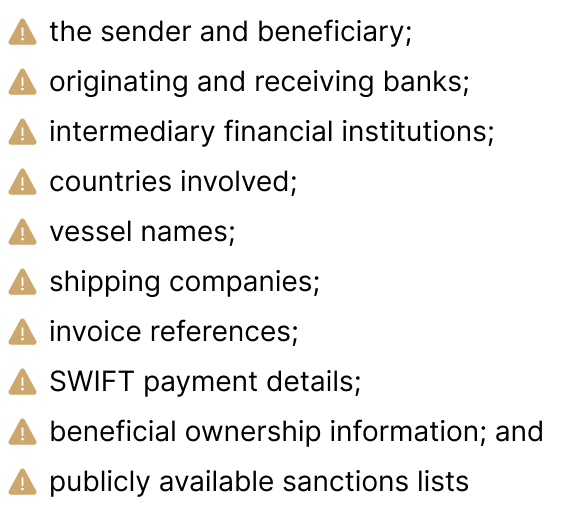
If the system identifies a potential sanctions concern, the payment may be stopped for additional review.
The bank, not OFAC, typically makes the initial decision whether to process, reject, or block the transaction.
Blocked vs. Rejected vs. Under Review
Understanding what actually happened to the payment is the most important step.
Blocked Funds
A blocked transaction means the funds have been frozen because U.S. sanctions regulations prohibit the transfer.
Generally, the funds remain in a blocked account maintained by the financial institution until OFAC authorizes their release or applicable sanctions no longer prohibit the transaction.
Although the funds are frozen, ownership generally remains with the original owner.
Rejected Transactions
A rejected payment is different.
The bank determines that it cannot process the transaction under applicable sanctions regulations, but there is no blockable property interest requiring the funds to be frozen.
Instead, the payment is generally returned to the sender.
Because the funds were never blocked, there is usually nothing to "release."
Payments Under Investigation
Sometimes the payment has neither been blocked nor rejected.
Instead, the bank temporarily suspends processing while collecting additional information.
The bank may request:
- contracts;
- invoices;
- shipping documents;
- corporate records;
- beneficial ownership information;
- identification documents; or
- explanations regarding the purpose of the transaction.
Many reviews conclude that the payment may proceed after additional documentation is provided.
Internal Bank Risk Decisions
Even if OFAC regulations would permit a transaction, a bank may nevertheless decide not to process it.
Financial institutions routinely adopt internal compliance standards that exceed minimum legal requirements. A bank is generally not obligated to process every transaction simply because it would be legally permissible.
Why Legitimate Payments Are Sometimes Frozen
Many interrupted transactions do not involve sanctions violations at all.
Banks increasingly rely upon automated screening systems designed to identify potential sanctions risks.
These systems intentionally generate alerts whenever uncertainty exists.
Common reasons include:
- similar names;
- spelling differences;
- transliteration issues;
- incomplete identifying information;
- common surnames;
- outdated customer records;
- vessel names;
- shipping routes;
- intermediary banks; and
- beneficial ownership concerns.
The overwhelming majority of alerts require additional review before the bank reaches a final determination.
False Positives Are More Common Than Many Businesses Realize
A sanctions-screening alert is not a legal determination.
Rather, it is a signal that additional due diligence may be necessary.
For example, a payment to "Mohammad Ali Trading" may trigger review because multiple sanctioned individuals have similar names.
Likewise, companies with similar names, identical addresses, or incomplete corporate information may generate automated alerts despite having no connection to sanctioned parties.
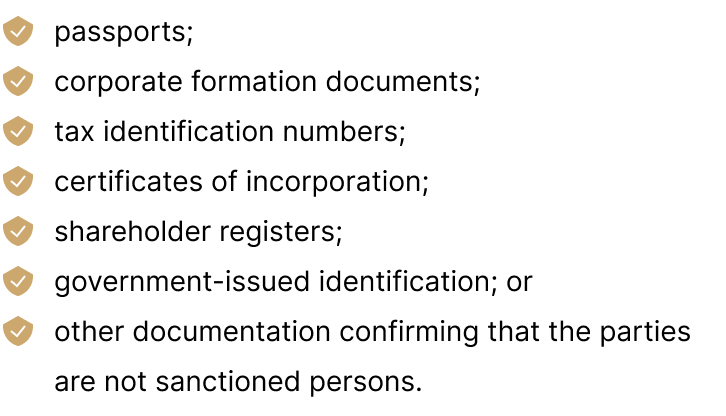
Often, these issues can be resolved by providing:
Understanding OFAC's 50 Percent Rule
Many businesses mistakenly believe that if a company does not appear on the Specially Designated Nationals (SDN) List, the transaction is automatically permissible.
That is incorrect.

Consequently, sanctions due diligence should include beneficial ownership analysis—not merely review of the SDN List.
Do Not Immediately Send Another Wire
One of the most common mistakes businesses make is attempting to resend the payment through another bank.
Doing so may:
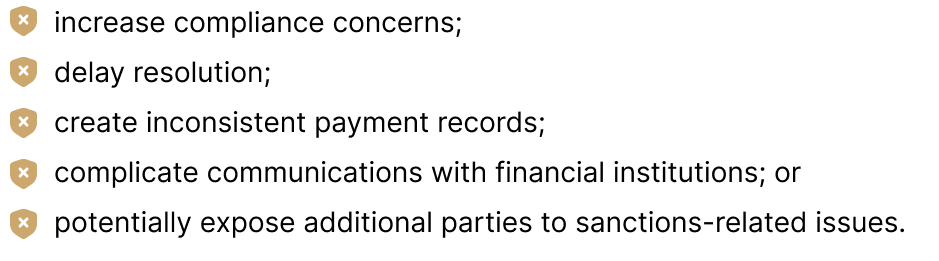
Instead, businesses should first determine precisely why the original transaction was interrupted.
What Information Should You Request from the Bank?
Promptly request written clarification.
Specifically ask:
- Was the payment blocked or rejected?
- Is the transaction merely under review?
- Which institution currently holds the funds?
- Which sanctions concern triggered the review?
- What additional documentation is required?
- Has any report been submitted to OFAC?
Obtaining these answers early frequently shortens the resolution process.
Preserve Every Relevant Document
Documentation is critical.
Immediately preserve:
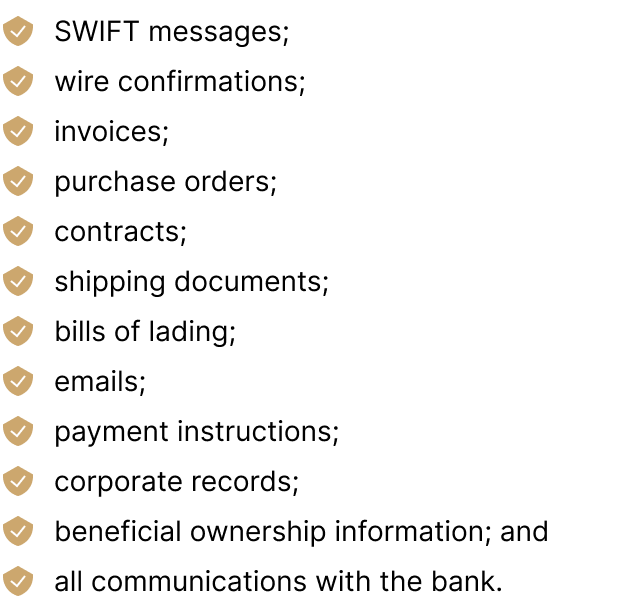
These materials often become essential when communicating with financial institutions or preparing an OFAC license application.
Determine Whether an Authorization Already Exists
Not every sanctions program prohibits every transaction.
The legal analysis should determine whether the transaction qualifies under:
- a statutory exemption;
- an applicable General License;
- a previously issued Specific License; or
- another regulatory authorization.
General Licenses are self-executing.
However, every condition of the license must be satisfied.
Simply citing a General License is usually insufficient; the parties must demonstrate that the transaction falls squarely within its scope.
When Is a Specific License Required?
If no exemption or General License authorizes the transaction, the parties may need to apply to OFAC for a Specific License.
A strong application generally includes:
- detailed factual background;
- contracts;
- invoices;
- payment records;
- corporate ownership information;
- identification documents;
- correspondence;
- shipping documentation; and
- a legal explanation supporting the requested authorization.
Each application is reviewed individually.
Neither approval nor any specific processing timeline can be guaranteed.
Can Blocked Funds Be Released?
Yes.
Depending upon the circumstances, blocked funds may be released when:
- the bank determines that the transaction was blocked by mistake;
- an applicable General License expressly authorizes release;
- OFAC issues a Specific License;
- sanctions are modified or terminated; or
- the blocking institution obtains an appropriate Compliance Release from OFAC.
The appropriate remedy depends entirely upon why the payment was blocked.
Common Mistakes Businesses Make
Businesses frequently make avoidable errors after learning that a payment has been interrupted. These include:
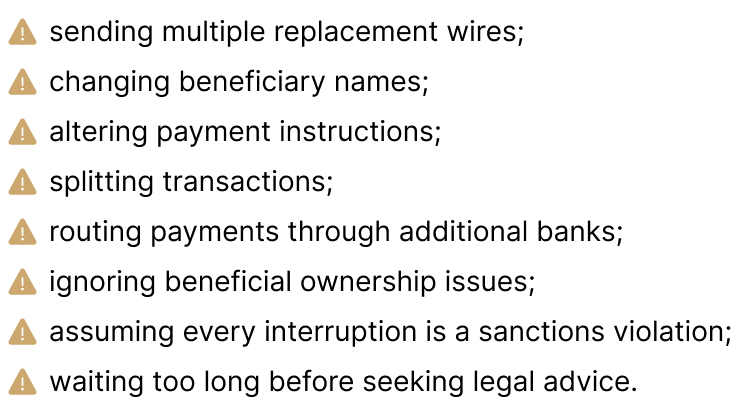
Early legal analysis often reduces delays and prevents unnecessary complications.
Frequently Asked Questions
Why did my bank freeze my international wire transfer?
Banks screen international payments to comply with U.S. sanctions regulations. A transaction may be delayed because of sanctions concerns, a false-positive screening result, incomplete documentation, or the bank's own compliance policies.
What is the difference between blocked and rejected funds?
Blocked funds are frozen and generally remain in a blocked account until lawfully released. Rejected payments are ordinarily returned to the sender because they cannot be processed but do not involve blocked property.
Can OFAC blocked funds be released?
Yes. Depending on the facts, blocked funds may be released pursuant to an applicable General License, a Specific License issued by OFAC, a Compliance Release requested by the blocking institution, or because the bank determines that the original blocking decision was incorrect.
Can I resend the payment through another bank?
Generally, no. Attempting to reroute the transaction before identifying the reason for the interruption may create additional sanctions compliance concerns and delay resolution.
What documents should I preserve?
You should retain all transaction-related records, including payment confirmations, SWIFT messages, contracts, invoices, corporate records, shipping documents, beneficial ownership information, and communications with the financial institution.
How long does an OFAC license application take?
There is no standard processing time. The review period depends on the applicable sanctions program, the complexity of the transaction, interagency consultation, and OFAC's workload.
What is a false positive?
A false positive occurs when sanctions-screening software incorrectly identifies a lawful transaction as involving a sanctioned person or entity. Many false positives can be resolved by providing additional identifying information and supporting documentation.
Does every interrupted payment mean a sanctions violation occurred?
No. Many transactions are delayed solely because a bank requires additional documentation or because automated screening identified a potential match that ultimately proves incorrect.
Practical Checklist After an OFAC Payment Freeze
If your payment has been interrupted:
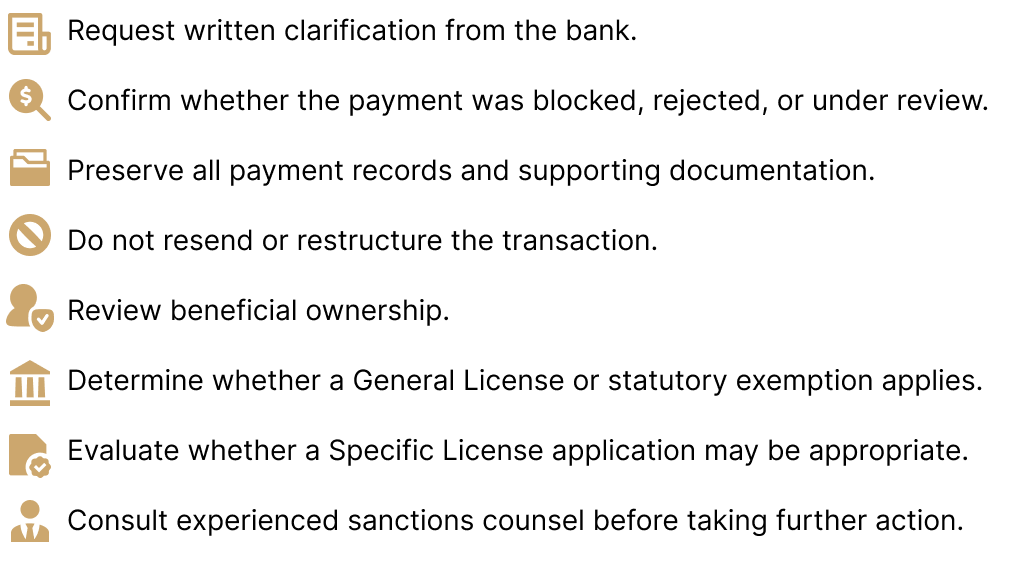
Conclusion
A wire transfer interrupted because of OFAC sanctions can be frustrating and commercially disruptive, but it does not necessarily mean that the transaction violated U.S. sanctions laws or that the funds are permanently inaccessible. In many cases, payment interruptions result from automated sanctions screening, false-positive matches, requests for additional documentation, or financial institutions applying internal compliance standards that exceed regulatory requirements.
The key is to determine exactly why the payment was interrupted before taking any further action. Whether the transaction was blocked, rejected, or merely placed under review will determine the appropriate legal strategy. Attempting to reroute the payment or modify the transaction without first resolving the underlying sanctions issue may create additional legal and compliance risks.
Businesses engaged in international trade should act promptly by
- preserving all transaction records,
- communicating with the financial institution,
- reviewing the applicable sanctions program,
- analyzing beneficial ownership, and
- determining whether a statutory exemption, General License, or OFAC Specific License may authorize the transaction.
A thorough legal analysis at the outset often helps reduce delays, facilitates productive discussions with financial institutions, and improves the likelihood of resolving the matter efficiently.
Because U.S. sanctions laws are highly technical and fact-specific, businesses facing blocked or rejected international payments should seek experienced legal counsel before restructuring a transaction or submitting an OFAC license application. Early strategic guidance can help protect commercial relationships, minimize regulatory exposure, and increase the likelihood of a successful resolution.