
 ES
ES  RU
RU  TR
TR  FA
FA  AR
AR  ZH
ZH Blog
Blog description

INTERPOL and U.S. Immigration: How Red Notices and Diffusions Affect Visas, Green Cards, and Naturalization
INTERPOL Red Notices and diffusions can create serious U.S. immigration consequences even when the person has never been convicted of a crime. A Red Notice is not an international arrest warrant; INTERPOL describes it as a request to law enforcement worldwide to locate and provisionally arrest a person pending extradition, surrender, or similar legal action, while each country decides under its own law whether to arrest the person.
For immigration purposes, however, the practical effect can be substantial. A Red Notice or diffusion may trigger visa delays, consular administrative processing, secondary inspection at the border, requests for evidence in adjustment or naturalization cases, discretionary concerns, good moral character issues, or even referral to enforcement agencies.
The central legal point is this: an INTERPOL alert is not a conviction. But it may cause U.S. immigration authorities to scrutinize the underlying allegations, the foreign criminal case, the reliability of foreign records, and whether the matter raises inadmissibility, removability, national-security, extradition, or discretionary concerns.
What Are INTERPOL Red Notices and Diffusions?
INTERPOL is not a global police department. It does not prosecute criminal cases, conduct trials, issue criminal judgments, or independently arrest individuals. It is an international law-enforcement information-sharing organization.
A Red Notice is an international alert concerning a person wanted for prosecution or to serve a sentence. INTERPOL states that Red Notices are published at the request of a member country and must comply with INTERPOL’s Constitution and Rules.
A diffusion is different. It is usually circulated directly by a member country’s National Central Bureau to selected countries or to all INTERPOL member countries. Diffusions can be less visible than Red Notices and may not appear on INTERPOL’s public website. INTERPOL states that Notices and Diffusions must comply with its Constitution and Rules on the Processing of Data.
This distinction matters in immigration cases because an applicant may be affected by INTERPOL data even when no public Red Notice appears online. INTERPOL confirms that most Red Notices are restricted to law-enforcement use only.
Why INTERPOL Alerts Matter in the U.S. Immigration Cases
U.S. immigration agencies may encounter INTERPOL data during background checks, visa screening, border inspection, adjustment of status, asylum review, removal proceedings, green-card renewal, or naturalization.
An INTERPOL alert may affect:'
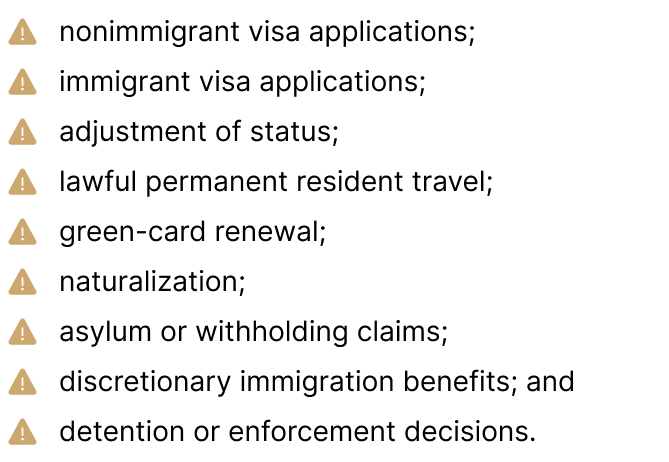
The risk does not come from the Red Notice alone. The greater risk usually comes from the underlying foreign allegation and how U.S. immigration authorities interpret it.
For example, a foreign government may allege fraud, embezzlement, corruption, tax crimes, money laundering, extremism, or other offenses. Depending on the facts, U.S. authorities may examine whether the allegation could implicate criminal inadmissibility, controlled-substance grounds, money-laundering concerns, national-security concerns, fraud or misrepresentation, or general discretionary denial.
Visa Applications: Consular Screening and Administrative Processing
A visa applicant must generally disclose arrests, charges, convictions, and criminal history as requested on visa forms. The Department of State’s Foreign Affairs Manual provides that criminal inadmissibility may apply where an applicant has been convicted of, or admits committing, certain statutory offenses involving moral turpitude under U.S. or foreign law.
A pending foreign charge or INTERPOL alert does not automatically equal a conviction. However, it may cause the consular officer to place the case into administrative processing or request additional documents, including:
- police certificates;
- court records;
- charging documents;
- arrest warrants;
- evidence of dismissal or acquittal;
- proof that the case is politically motivated;
- asylum or human-rights evidence; and
- explanation of the foreign legal process.
In practice, a Red Notice or diffusion may create a significant obstacle even where there is no conviction, because consular officers may require additional review before deciding whether a statutory ground of inadmissibility applies.
Green Cards and Adjustment of Status
For adjustment of status, USCIS examines whether the applicant is admissible to the United States and whether the application should be approved as a matter of discretion. An INTERPOL alert may lead USCIS to request evidence about the foreign case or to investigate whether the allegations implicate inadmissibility.
Important issues include:
A. Criminal Inadmissibility
USCIS may examine whether the underlying conduct involves a crime involving moral turpitude, controlled substances, multiple criminal convictions, trafficking, prostitution-related offenses, money laundering, or other inadmissibility grounds.
But the existence of an INTERPOL notice alone is not the same as proof that the applicant committed the alleged offense.
B. Discretionary Denial
Even where no formal inadmissibility ground applies, USCIS may consider unresolved allegations as part of a discretionary analysis. The applicant should be prepared to show that the foreign case is unreliable, politically motivated, unsupported, procedurally defective, or inconsistent with basic due process.
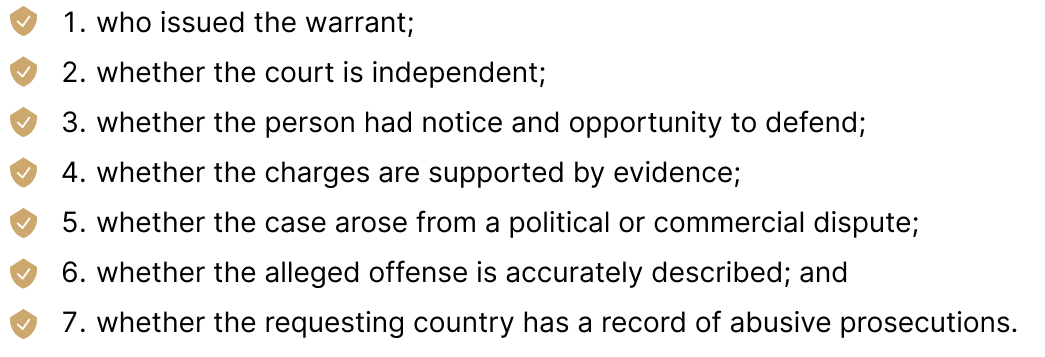
C. Reliability of Foreign Evidence
Foreign criminal documents are not all equal. A serious legal response should analyze:
Lawful Permanent Residents and International Travel
A lawful permanent resident who is the subject of an INTERPOL alert may face heightened risk during international travel. The person may be referred to secondary inspection, questioned about the foreign case, asked for documents, or delayed while officers review law-enforcement databases.
A Red Notice does not automatically strip a green-card holder of LPR status. However, the border context can be unpredictable, especially if the underlying allegations are serious, if the person has been absent from the United States for an extended period, or if the government believes a criminal, security, or admissibility ground may apply.
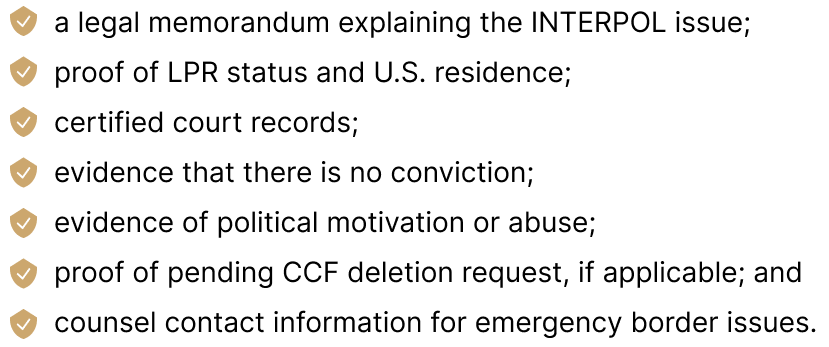
Before international travel, a green-card holder with INTERPOL exposure should consider preparing:
Naturalization: Good Moral Character and Foreign Allegations
Naturalization presents a separate set of risks. To naturalize, an applicant must establish statutory eligibility, including good moral character during the relevant statutory period. USCIS states that the applicable period during which an applicant must show good moral character depends on the basis for naturalization.
A Red Notice or diffusion may cause USCIS to question whether the applicant has good moral character, even without a U.S. conviction. USCIS may ask whether the applicant has been arrested, charged, detained, indicted, or involved in criminal proceedings anywhere in the world.
The legal response should emphasize the distinction between:
- conviction;
- pending charge;
- arrest warrant;
- investigation;
- unproven allegation;
- politically motivated prosecution; and
- unreliable foreign-source material.
USCIS’s Policy Manual recognizes permanent and conditional bars to good moral character, including certain convictions and unlawful acts. But an unresolved foreign allegation should not be treated the same as a final conviction unless the statute, regulation, and evidence support that conclusion.
The Key Legal Argument: INTERPOL Data Is Not a Conviction
A central defense point in immigration cases is that INTERPOL data is an investigative or law-enforcement alert, not an adjudicated criminal judgment.
A Red Notice may show that a foreign country claims a person is wanted. It does not, by itself, prove that:
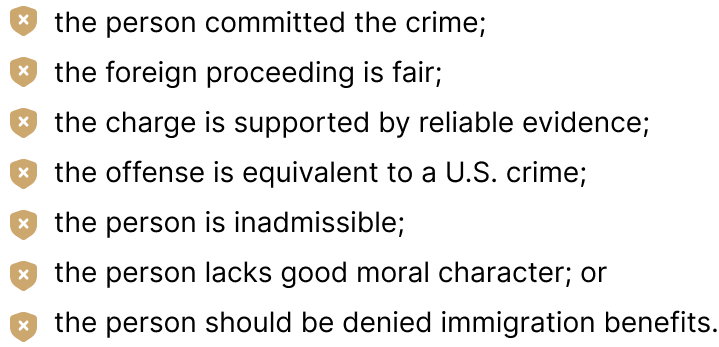
This distinction is critical in visa, adjustment, and naturalization matters.
Political Prosecution and Article 3 of INTERPOL’s Constitution
INTERPOL’s Constitution prohibits the Organization from undertaking activities of a political, military, religious, or racial character. This is commonly referred to as the Article 3 prohibition. INTERPOL’s compliance framework requires Notices and Diffusions to satisfy its legal rules, including constitutional limitations.
In immigration matters, an Article 3 argument may be relevant where the foreign case appears to arise from:
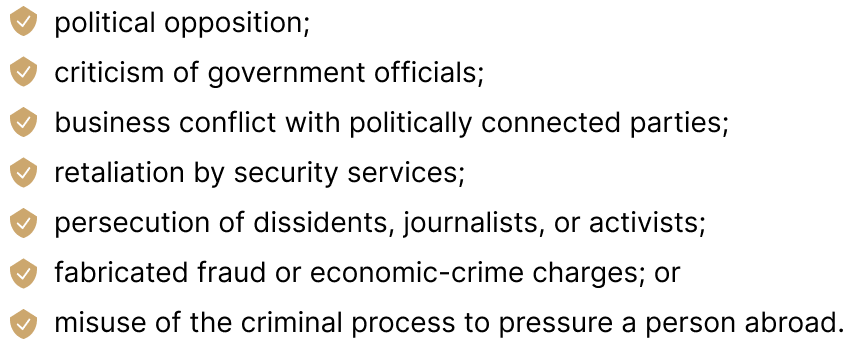
Where political motivation exists, the immigration strategy and the INTERPOL strategy should be coordinated. A CCF deletion request may become important evidence in the immigration record.
The TRAP Act and U.S. Policy Against INTERPOL Abuse
The U.S. Congress has recognized that INTERPOL mechanisms can be misused by authoritarian and abusive governments as tools of transnational repression. The Transnational Repression Accountability and Prevention Act, commonly known as the TRAP Act, was enacted as part of the National Defense Authorization Act for Fiscal Year 2022 and is codified at 22 U.S.C. § 263b. The statute reflects U.S. policy concerns about the misuse of INTERPOL Red Notices and diffusions against political opponents, dissidents, journalists, human-rights defenders, and other targeted individuals. For immigration purposes, the TRAP Act is significant because it supports the argument that U.S. authorities should not treat an INTERPOL Red Notice or diffusion as conclusive evidence of criminality, particularly where there are indications of political motivation, human-rights abuse, or procedural defects in the requesting country. ICE guidance similarly provides that ICE personnel generally may not rely exclusively on a Red Notice or wanted-person diffusion to justify enforcement action or use in immigration proceedings, and must verify validity, review potential abuse, obtain supervisory approval, and request underlying documentation through INTERPOL Washington where reliance is contemplated.
Challenging INTERPOL Data Before the CCF
The main body for challenging INTERPOL data is the Commission for the Control of INTERPOL’s Files, known as the CCF. INTERPOL states that individuals may request access to data concerning them in INTERPOL’s files.
A person may ask the CCF to:

A strong CCF submission should be carefully documented. It should include not only a denial of wrongdoing, but also legal and factual grounds showing why continued processing of the data violates INTERPOL’s rules.
Relevant evidence may include:
- foreign court documents;
- proof of procedural defects;
- human-rights reports;
- expert declarations;
- sanctions records;
- asylum materials;
- proof of political activity;
- business-dispute records;
- evidence of false media reporting; and
- inconsistencies in the foreign charges.
How a Successful INTERPOL Deletion Can Help Immigration Cases
Deletion of a Red Notice or diffusion does not automatically guarantee approval of a U.S. immigration application. But it can materially improve the record.
A successful deletion may help show that:
- INTERPOL found the data inconsistent with its rules;
- the foreign case has political or procedural defects;
- the alert should not be treated as reliable law-enforcement evidence;
- the applicant has taken formal steps to challenge the allegation; and
- U.S. immigration authorities should not rely on the INTERPOL alert as adverse evidence without independent proof.
For naturalization, this may be especially important where USCIS questions good moral character based on unresolved foreign charges.
Evidence Needed for U.S. Immigration Filings
Where INTERPOL data affects a U.S. immigration case, the applicant should consider submitting a structured evidentiary package. Depending on the case, this may include:
- personal declaration;
- certified foreign court records;
- proof of no conviction;
- proof of dismissal, limitation period, or procedural irregularity;
- expert opinion on foreign criminal procedure;
- country-condition evidence;
- human-rights reports;
- proof of political motivation;
- copy of CCF access or deletion request;
- CCF decision, if available;
- explanation of the difference between a Red Notice, diffusion, charge, and conviction; and
- legal memorandum addressing inadmissibility, discretion, and good moral character.
The filing should avoid conclusory statements. The strongest presentation is factual, chronological, documented, and legally tied to the immigration standard at issue.
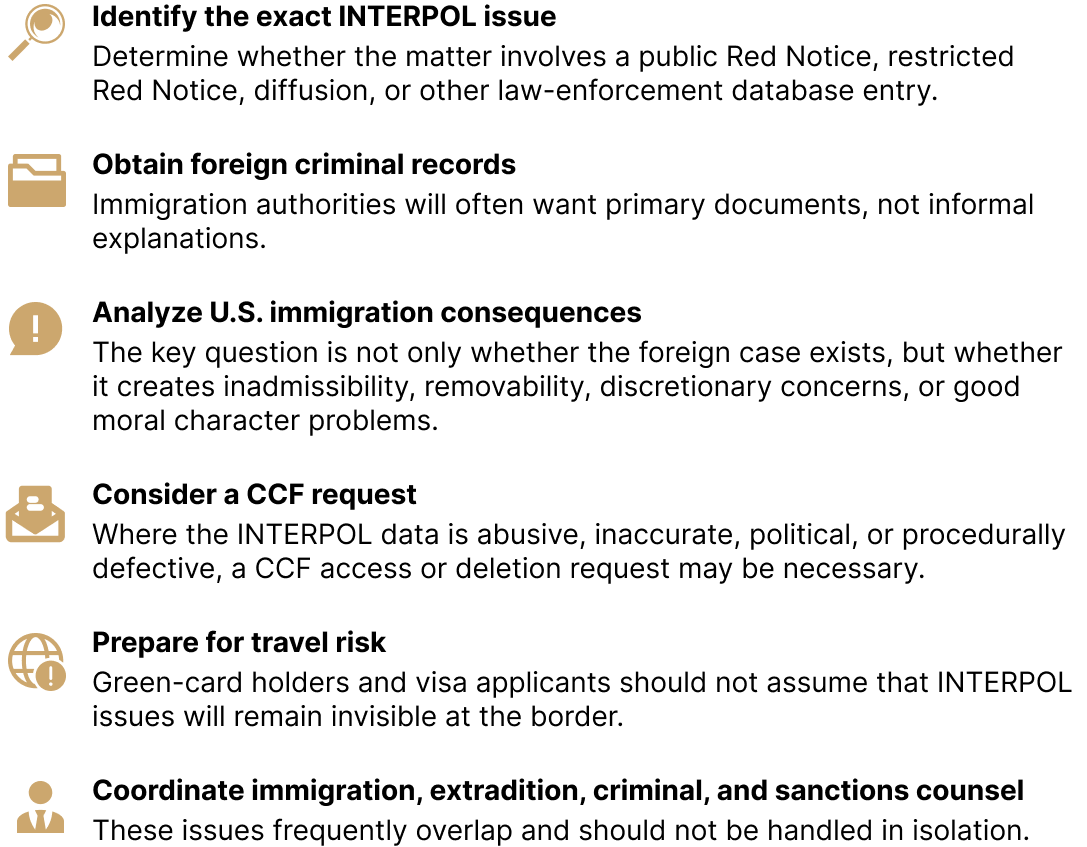
12. Practical Strategy for Affected Individuals
Individuals facing INTERPOL-related immigration issues should consider the following steps:
13. Common Mistakes
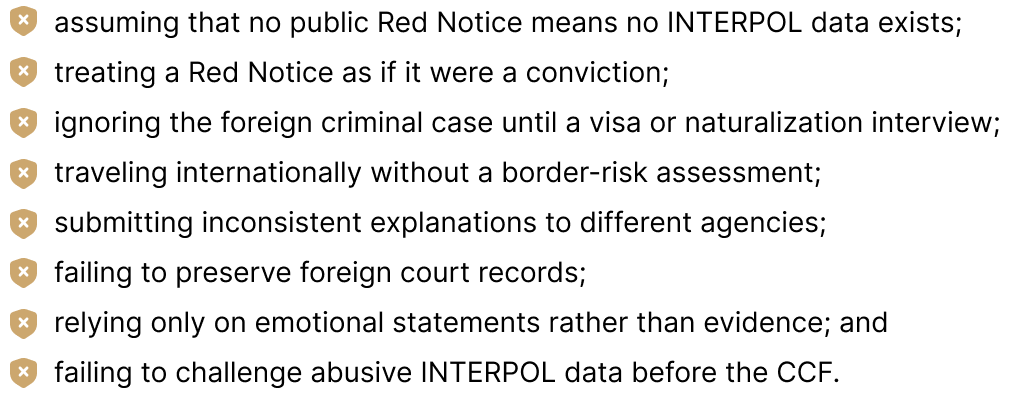
Common mistakes include:
Conclusion
INTERPOL Red Notices and diffusions can have serious U.S. immigration consequences. They may affect visa applications, green-card processing, international travel, adjustment of status, and naturalization. But an INTERPOL alert is not itself a conviction, and it should not be treated as conclusive proof of criminal conduct.
The proper response requires a coordinated legal strategy: analyze the foreign case, identify defects in the INTERPOL data, prepare immigration-specific arguments, gather evidence, and consider a formal request to the CCF for access, correction, or deletion.
For individuals facing politically motivated prosecutions, abusive foreign criminal charges, or unreliable INTERPOL alerts, the difference between a weak explanation and a documented legal strategy can be decisive.